My lead white is in safflower, the titanium white lists alkali refined linseed oil.

1 Like
Hey guys,
In a related bit of research I had to go back and review the excerpts from the book we often cite “Hess Paint Film Defects: Causes and Cure.” I actually realized that the phthalo pigments are ALSO MENTIONED in addition to the titanium and carbon black mixtures. Here’s the full section extracted from the book (not all seems applicable to our scenario but still pretty interesting!):
Flooding and Flotation; Mottling; Silking; Striations
Flooding is a defect which appears soon after application in many gloss finishes containing two or more pigments differing appreciably in particle size, specific gravity (there are exceptions to this) and possibly wetting characteristics [1]. Typical pigment mixtures giving rise to the defect are titanium dioxide/phthalocyanine blue [2], titanium dioxide/carbon black and lead chrome/Prussian blue (chrome greens). The effect is a gradual and uniform deepening of the colour of the surface which dries to a deeper shade than the bulk of the paint [3].
Flotation (or floating) resembles flooding in that one pigment appears to “float” to the surface, but the latter assumes a mottled appearance and close examination reveals the existence of hexagonal Bénard cells (Figs. 4.1 and 4.2). The mottled appearance is due to differences in pigment concentration between the edges and centres of the cells. As a consequence of the differences in concentration, strains are likely to be set up in the film, particularly on weathering. It is possible that certain forms of checking (e.g. “crowsfoot”) may originate in this way.
Silking is an effect observed on dipped articles where, as a result of drainage, the Bénard cells have become elongated giving the surface a silky appearance.
Striations (or “streaks”) are produced on brush or dip application of paints where one of the component pigments (usually the stainer) has flocculated. The flocculates break down under the shear produced by brushing or drainage and produce striations or streaks of deeper colour.
Faults Related to Drying and Curing
During the process of solvent evaporation from a wet paint film, convection currents are set up while the film is still fluid, and these carry some of the pigment particles to the surface. The particles are usually the finest and often (but not invariably — see below) those of lowest specific gravity. Any tendency to flocculation by these particles appears to assist the process.
The type of solvent evaporation exerts a profound effect on the type of surface pattern produced. Under equilibrium conditions solvent evaporation is by a diffusive process and results in flooding or uniform distribution of pigment in the surface. When the solvent vapour is removed rapidly by air circulation, evaporation becomes ebullioscopic and takes place from points in the film. This leads to Bénard cell formation and a mottled appearance on the surface (flotation).
Flotation can take place with single pigments but is not often evident. The Bénard cells (many of which will be elongated) can be seen clearly if a droplet of an alkyd paint, pigmented with toluidine red, is placed on a flat surface and examined under low magnification. In thixotropic paint systems pigment mobility is very restricted and therefore flotation is least likely to occur.
The addition of certain silicone oils (1 part to about 40,000 parts of paint) will often convert flotation into the less objectionable flooding. Certain proprietary materials (e.g. Troykyd Anti-Float), at 2 to 2.5% on the weight of pigment, will sometimes reduce both floating and flooding significantly. The effect of this additive varies from one medium to another.
The incorporation of finely divided extenders (e.g. Aerosil, Calofort S, Calofort T) can reduce floating considerably [4]. However, in view of the pronounced flattering effect exerted on gloss finishes by extenders of this type, care must be taken to control the quantity used.
The type of flotation can be influenced by the relative humidity of the air. In coloured paints containing titanium dioxide, floating of the hydrophilic titanium dioxide has been observed [5] at high humidities whereas under drier conditions the reverse has been found to occur.
Electrostatic effects (charges on pigment particles) appear to influence flotation. An increased tendency for this defect to appear has been observed when paint films have been applied by electrostatic spray.
Certain paints produced by the blending Prussian blue with lead chromes (chrome or Brunswick greens) are more prone to blueing, i.e., floating or flooding covering the blue component, than those made by using co-precipitated “struck” greens.
Because modern methods of high-speed dispersion, together with basic improvements already achieved in techniques of organic pigment manufacture, have considerably reduced the frequencies of flooding and floating [6].
Frequent causes of these faults are:
(a) Insufficient mixing with paints before use. Fully automated spraying equipment is fed from paint reservoirs which are stirred continually.
(b) Charging of parts freshly sprayed with stoving lacquers into the hot stoves. (Specially sensitive to this fault are, e.g., the thermo-hardening enamels, based on phenol resins.)
(c) The freshly applied film should if practicable be subjected to a preliminary air-drying (flash-off) period of 15 to 30 min, or should be charged into a stove of low temperature, up to 20–30°C (70–85°F). Quick-drying coatings are more endangered.
(d) Too close packing in stoves of the enamelled articles possibly in conjunction with too rapid temperature increase.
(e) Excessively thick films due to heavy application or too high viscosity, especially on spraying. The faulty appearance of the films is particularly in evidence where the film layer is heaviest, e.g., if a full layer of a thin part or lacquer is sprayed on or dried until the edges are not lying horizontally so that an uneven film thickness is formed (Fig. 4.3).
Sometimes hexagonal Bénard cell structures are formed coupled with bubbling (solvent escape prevented by skinning over), particularly if hot sprayed to a cold surface. Winter mornings are especially dangerous.
Faults due to surface tension, insufficient wetting, flotation and different specific gravity of a paint are less visible with thin films.
Pigments should be stored as dry as possible.
(f) Existence of an extremely moist, air-absorbed base.
(g) Unsuitable solvents or thinners. If they are fast evaporating they favour flotation. Polar solvents, e.g., acetone, butyl alcohol, etc., should not be present in large quantities.
(h) Metal soap formation in situ, e.g., by reaction of zinc driers with alkyd resins resulting in the formation of zinc phthalate, can produce flotation.
(i) Brushing with a too coarse bristled brush. The opinion that occasional brush marks, in that where the paint film is thinnest, is possible under great stresses cannot be denied.
Enamel or spirit brushes are best.
Use a more flexible brushing technique, employing the brush-tip, i.e., the tapered parts of the bristles, for “laying off.”
(j) Use of one brushing method in connection with too rapid drying paint materials or in excessively warm surroundings.
(ii) Employ another method of application such as, for instance, spraying, where possible, or use another more easily and satisfactorily brushable paint material.
(k) Add some heavy thinners, e.g., white spirit, turpentine where oil-base coatings are concerned; otherwise, e.g., one of the glycol esters. Make sure, however, that these are compatible with the medium of the paint.
(iii) In the case of water-based and emulsion paints where brush marking occurs due to excessively warm conditions or very porous substrates, additional thinning may be desirable or the use of a prepared solution instead of water in order to give improved wet-edge time, i.e., use aqueous thinners containing colloidal thickeners, emulsion, etc.
(l) Using paint materials too stout for brushing, e.g., semi-prepared. This may cause streaked or checkered appearances of the film similar to those caused by spraying and dipping.
Pronounced colour differences can be observed between paint surfaces which have been brushed on in different directions.
Either thin the too thick material to suitable viscosity or employ a paint which is better qualified for brushing.
(m) Coating which contain a high percentage of low-boiling solvents or thinners may show streaky films, especially if application is coating by roller. The rotation of the rollers produces air-currents, thus quicker evaporation of the highly volatile constituents resulting in uneven films. Dirt on the scraper (leveller) which at times used shows up on repeated rotation in the form of streaks (reverse brush marks).
However, coatings produced by reverse roller coating give more uniform results than knife coating.
Sometimes uneven absorption of e.g., fibrous material is to blame. Addition of high-boiling thinners may be helpful. The room temperature should be well watched.
Mechanical knife-coating may have its advantages for cardboard, fabrics and paper, venetian blinds etc., when stout coatings are to be applied with low speed. Curtain coating machines have found entrance for the even application of nitro-cellulose lacquers and polyesters to flat wood panels etc. as relatively thick, mostly unpigmented films.
So in reading through this again, I would argue that flooding/flotation mechanisms indeed are playing a part here. Binder contraction still offers a structural explanation: as the oil shrinks around pigment during polymerization, the refractive index environment changes, especially in high-scatter pigments like TiO₂. I do believe that Hess’ section reinforces that multiple mechanisms are co-occurring.
In addition, this morning during our round table, a few questions came up that are realted to this. I thought you all might find it somewhat interesting.
First, there was a little bit of confusion over a somewhat seemingly contradictory set of mechanisms: an oil paint film taking on mass during oxidation while it is also undergoing contraction/shinkage.
As you both know, oil paint films undergo both mass and volume changes as they cure. Early on, drying oils gain mass because they chemically bind oxygen during autoxidation; modern measurements show a rapid initial oxygen uptake of ~3–7% (by mass) within hours, while classic studies on pure linseed oil documented larger total uptakes on the order of ~10–20% under certain conditions—hence the often-quoted “~17%” figure. At the same time, volatile byproducts (and any added solvent) are lost, so the long-term mass can plateau or even decline depending on formulation and conditions. In parallel, crosslinking and molecular rearrangement cause volume shrinkage from the outset, so a film can gain mass while losing volume (i.e., density rises). Long-term, pigmented oil-paint films show measurable cumulative shrinkage (e.g., ~0.3–1.7% over decades in controlled studies), which is enough to alter surface gloss and scattering in thin, titanium-rich tints and helps explain wet-to-dry appearance shifts without invoking poor mixing or “floating” alone. In practice, the early mobility of the binder (hours–weeks) is the most optically consequential window—later changes continue but mainly manifest as gradual embrittlement and stress rather than fresh value jumps. (more on this in the second part.)
The second part of our discussion involved a challange to the potential binder shinkage component for voodoo darkening as contraction is ultimately a progressing process which can last for many years. So why wouldn’t the paint continue to get darker over time as the RI and scattering potential of titanium white should intuitively seem to continue to change? Here’s why:
It turns out that a binder-driven voodoo darkened mixture won’t keep getting darker forever because the main optical shift occurs during the early phase of curing, when the binder is still mobile. In the first days to weeks, the oil flows, contracts, and migrates around pigment particles, producing local changes in refractive index and pigment packing that cause the visible “voodoo darkening.” Once the binder develops a semi-rigid crosslinked network, large-scale migration largely stops, and the pigment–binder configuration—the “optical architecture” of the paint film—is essentially set. While crosslinking and chemical reactions continue for years, the film at that point is “glassy” (i.e., the oil binder has polymerized into a rigid, amorphous solid where optical architecture is “locked in.”) and relatively immobile, so further contraction contributes more to mechanical stress (leading to cracking or craquelure) than to new optical changes. Long-term alterations in appearance, such as darkening or discoloration, are instead dominated by chemical changes in the oil itself, including yellowing, the formation of oxidation products, or pigment interactions like zinc soaps or other metal carboxylates. These later effects can shift the appearance, but they are distinct mechanisms from the early-phase “voodoo” darkening.
Hope this additional info is insightful.
1 Like
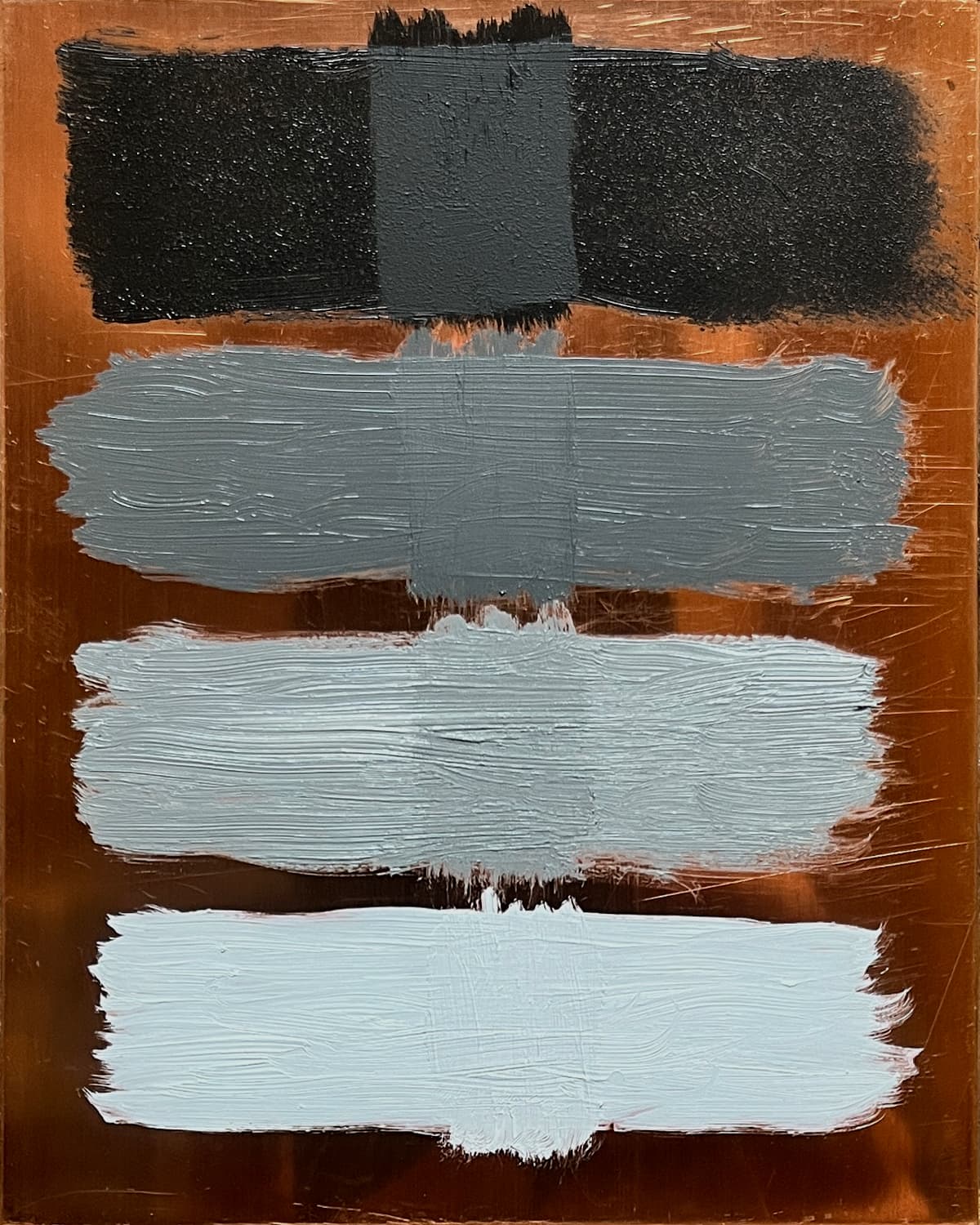
Some interesting results from my tests of the Williamsburg Neutrals, values 2, 4, 6 and 8.
I worked on copper panel to eliminate any potential issues caused by substrate absorbency. Copper does reflect back more light than traditional surfaces, but it’s perfectly smooth and adhesion is excellent. I worked with the Williamsburg Neutrals straight from the tube, without any additional medium.
• First stage: There are quite visible value shifts in the sixth value, and a few in the eighth value. Since I put on quite a thick layer of paint to eliminate any copper show-through I’m certain the streaks are from the paint itself.
• Second stage (vertical rectangles in the middle of each value):
• 2nd Stage Value Two is lighter than it is in the first stage, except what viewed from the side. This may be due to the more transparent quality of the Williamsburg Neutral Value 2. Holding a NG2 chip to the panel, I can see that the second stage value 2 is actually much closer to the Munsell Neutral Gray 2 chip. I would conclude that the copper darkened the first layer at 2nd value.
2nd Stage Value Four is a very near match to the first layer. It’s just slightly darker and I’d attribute that to the increased opacity the second layer brings to the paint. However, even though both layers are a very close match, they are not close enough to the Value 4 chip. They are slightly closer to the purple-blue than they should be, as well as being too light. If I mixed them I would need to adjust.
2nd Stage Value Six is a near match to first stage V6. Very slightly darker. No streaks visible, although the second stage is a much smaller area than the first.
2nd Stage Value Eight is the closest match to the first stage, and is likewise a match to NG V8.
As a frame of reference, I was part of the outside quality control team when Williamsburg was prototyping the Neutral Grays. The original set matched exactly, but they may not have been exactly when they changed the formulation. There could be an effect due to the copper, and this point is actually beyond the scope of the VD investigation, but it may tie in.
First Stage:

1 Like
Hey Richard–quick note–I fixed your user trust level so that you may post multiple images in one post. It’s a spam prevention thing but you shoule be fine now. 
Thanks Anthony! Much appreciated!
There’s definitely texture, Maneesh. And the streakiness is a separate phenomenon, clearer in person than the photo.
I might do another where there is no texture.
1 Like
(sorry this took to long)
Ok, long story short, I think I caught the effect but with a twist…it showed up pretty clearly in my lead white V6 mix. The wet mixture from the freezer appears a solid munsell step higher than the dry swatch, I think it’s pretty clear in the picture (bottom left).
I made separate swatches and painted over the dried swatch put down a little over a week ago.
I oiled out my swatches (soaked them a bit more than I would a painting) before applying the wet paint over them. I don’t see other surprising effects from freezing on the controls. Any small differences I see between wet an dry paint seem small. I am a bit troubled because I matched to 6 on the munsell card and was within the half steps (hard to match exact exactly since I am not matching hue or chroma). I could feel the paints with my palette knife, the titanium was much runnier and not ropey the way the lead white is, I don’t think there is any way I got paints mixed up. I am a little terrified if I was somehow sloppy in picking paint off the palette to put in the freezer box…but I was awfully careful.
Did the freezing do something to the lead white mixture?
I’ll repeat pretty soon, but the effect seemed pretty stark here and feel like it should work again.

1 Like
I see the effect, Maneesh.
The streakiness in my original layer dried more pronounced.
I did not oil out at all. Was that part of the suspect protocol?
I guess I’ll do some with frozen paints, lead and titanium.
2 Likes
I don’t know what the original protocol was but it was important to oil out here to ensure that that both wet and dry swatches have an oil layer on top. When I oiled out all the swatches the changes were quite minimal, nothing like 1 munsell value step.
I am getting so paranoid that I somehow added white paint to my mixture, I don’t get how I would’ve though. I don’t have a good video setup to record from overhead, but I’ll try and rig something.
1 Like
I don’t oil out very often so I didn’t, but I have room for another patch and paint that has been in the freezer for a few weeks. I’ll have another go at it.
I doubt that you would have mixed white in, given how organized we are trying to be.
I have a feeling my lightened swatch is darkening. I’ll take a picture in a day or two to see how low the contrast can get, it isn’t quite matching yet on the swatch painted over the 1w old swatch, but the swatch on paper seems quite close.
So something is going on I don’t understand. I’ll post my replication in the upcoming days and then I think solving this will require a paint industry expert. I would be nice to see some microscopy on the swatches.
2 Likes