Many of us have read about the potential changes we might observe when oil paint dries. Dry oil paints can appear to darken or lighten depending on everything from the absorbancy of the ground (sinking) to the quality of light found where the painting is displayed or stored. The general understanding regarding the later is that dry oil colors in a painting take on color in the dark, and bleach back out in the light. For more on the impact of light on oil colors: https://gamblincolors.com/storing-oil-paintings/ and Ralph Mayer’s The Artist’s Handbook.
However, a different phenomenon has recently been making the rounds in some online material forums that has been dubbed “voodoo darkening.” The issue is described as an unexplained significant value change (although mostly darkening) in drying or dry oil paint. It is not a new problem according to many speaking on the issue online, but rather seems to be an issue that has recently caught traction on a few forums as of late. The issue does not seem to be fully attributable to the aforementioned sinking or lighting, but MAY still be related in some way as material gurus like Natural Pigment George O’Hanlon continue to gather data. In an early addressing of an array of questions on this topic, George writes on his Facebook Painting Best Practices page “There is no one culprit in this phenomenon so testing is very difficult.”
However artist Julie Beck from ARA Boston wasted no time and has been doing some informal testing of her own to further explore the phenomenon. She shared the following results online:
Test Panel while wet, all matched exactly to Munsell neutrals. RGH and Winsor Newton on this panel (WN also contains zinc). Painted both thinly and thickly in each patch

Dried paint swatches (not sunken in) with fresh tubed paint painted on the bottom half of each square. You can see that the wet paint is lighter on most of these swatches. The Winsor Newton is top row and the RGH is lower row. Summary so far: The thinner it was painted, the darker it dries.

Close up of wet and dry paints

Close up of wet and dry paints
This phenomenon, according to online reports and statements, is not limited to any one paint brand or medium. However, many have claimed a strong increase in occurrence when Titanium White is involved. However, fewer report an issue with pure titanium and report that only mixtures seem to produce a value shift. (In fairness though, it would likely seem that pure white shifts would be far less perceptually noticeable.)
Our own @dianedavichcraig had a engagement with this phenomenon recently and was kind enough to record and share her experience:

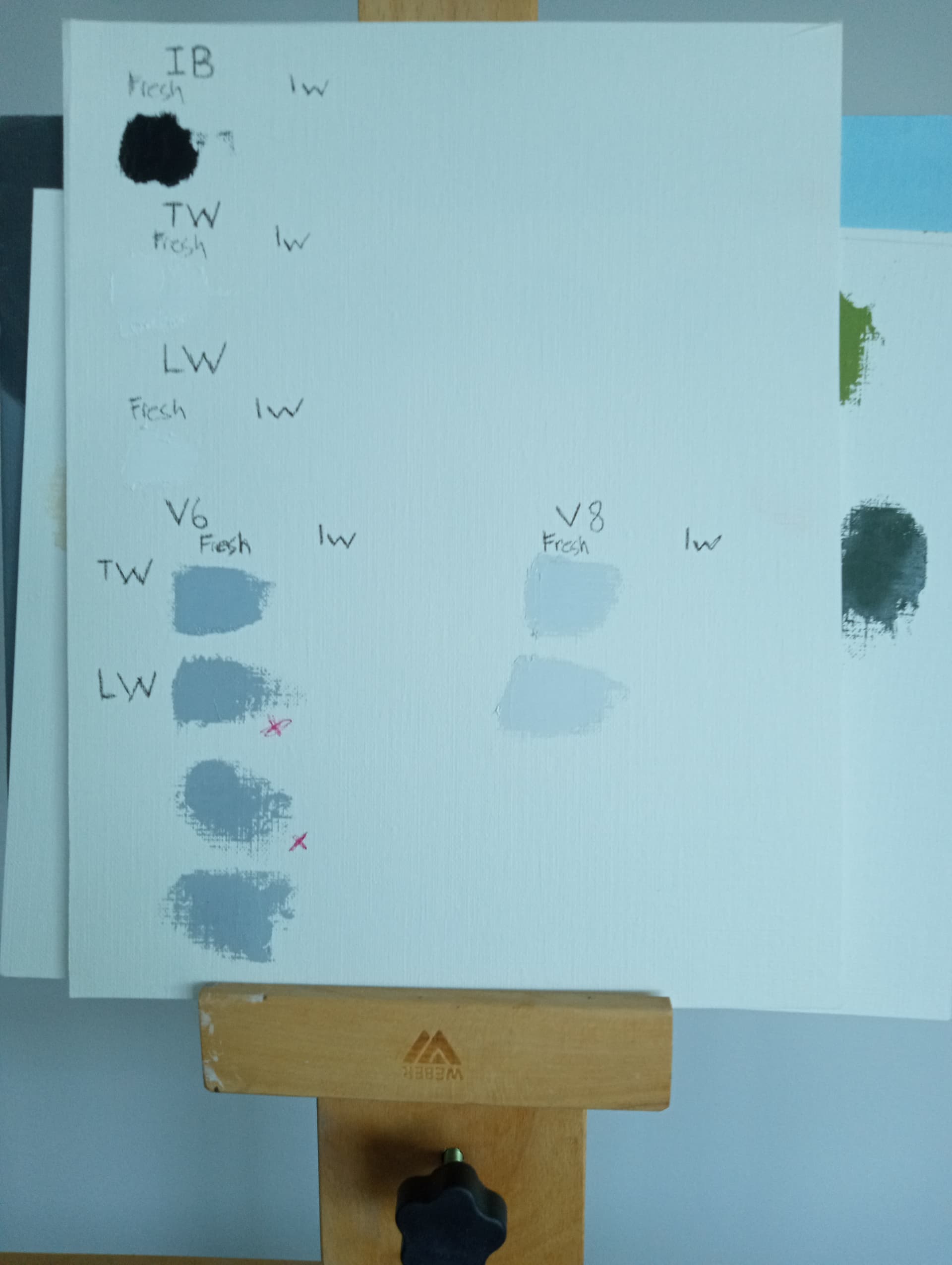
Layer one of gray paint straight from the tube of Williamsburg Neutral Gray No 8. Composition: PW6 Titanium Dioxide Rutile, PBK6 Nearly Pure Amorphous Carbon, PY13 Hydrated Iron Oxide, PR102 Calcined Natural Iron Oxide. Plus Old Masters Italian Wax Medium ( Maroger Medium) Painted on Ampersand Gessoboard. Layer 1 of gray paint straight from the tube. No problem appeared when I first put down the paint.

Problem developed of a darker gray stripe right over the onions. Beginnings showing here after putting in the onions and second layer of gray.

After covering the dark spot in farther left and farther right spots then a darker spot appeared in the middle parts lacking the touch up (didn’t look like it needed a touch up when touch up was done.)

Then after going over entire gray again (everything from top of the board to the onions) a lighter stripe appeared (hard to see in this photo but it was there) and it was showing up in addition to the darker stripe still evident (but not as much). And it had a slicker texture.

Then as I was oiling out with a makeup sponge I nicked the paint in 2 spots with my fingernail! (No words I can print here) So I slightly sanded and filled in the small nicks.

Finally after one more coat only over the stripes, nicks and slickness it resolved.

Finished piece! Frustration Factor 8 out of 10. (Scale: 1 being adding a happy white highlight dot and 10 being painting a dollar bill.)
I will be sure to update this article is more information is brought to light. Please let us know if you have any experiences regarding this phenomenon to share below!
3-23-21 Update: Colleague @Maneesh_Yadav has presented a promising line of investigation on this topic. Read about his effort to explain this phenomenon here:
8-27-25 Update — Titanium White + Phthalo Turquoise and adding “Contraction/Packing” to our Hypothesis:
A recent case involving a tint—Williamsburg Titanium White + Williamsburg Turquoise (PW6, PG7, PB15:3)—showed the same “voodoo darkening” many of us associate with TiO₂ + carbon black. That pushes me to a broader account: yes, floating/flooding can contribute in some systems, but a contraction/packing + refractive-index + dependent-scattering mechanism may be closer to the explanation (aligning with George’s “multi-culprit” label.)
Why the floating/flooding dynamic alone may not be sufficient:
Floating/flooding is not just about pigment particle size—but often includes strong differences in pigment stabilization, surface chemistry, or convective flow (bulk movement of liquid caused by gradients (in temperature, composition, or surface tension) during cure; it’s classically invoked for TiO₂ + carbon black. However, it doesn’t necessarily hold as strong with the darkening in TiO₂ + phthalo tints. Particle-size contrasts exist there too, but they are not extreme enough to make flotation inevitable across all binders and conditions:
-
TiO₂ (rutile PW6) for coatings is engineered around 0.2–0.3 µm to maximize visible-light scatter. tipure.com SpecialChem
-
Phthalo PB15:3 / PG7 dispersions are commonly tens to low-hundreds of nm (grade and processing dependent). MDPI PMC
-
Carbon black primaries are ~10–80 nm, but the effective aggregates in coatings can be far larger; “size disparity” is not always one-way. Orion ScienceDirect
So while flooding/floating can and does occur (and can be investigated further, of course), this phthalo case seems to contribute to the idea that there is likely additional “stuff” going on.
How contraction/packing + RI (refractive index) shift + dependent-scattering may be doing some of the “heavy lifting” here:
-
Film shrinkage and packing. As drying oils cure, paint films shrink and stiffen; long-term measurements show cumulative shrinkage on the order of ~0.3–1.7% in controlled films (pigment-dependent). That is small, but enough to alter inter-particle spacing and contact states near the surface. Tighter spacing and incipient flocculation push the system from “independent” toward dependent scattering (what happens when pigment particles in a paint film don’t scatter light independently anymore—each particle’s scattering is influenced by its neighbors.), which reduces back-scatter efficiency* of TiO₂ and lowers hiding per unit TiO₂. Result: the chromatic component reads darker/more saturated in the dry film. Nature ResearchGate users.physics.unc.edu *(*Note: Back-scatter is light that gets sent back toward where it came from after hitting a surface or passing through a material. Backscatter efficiency describes how well a paint film is at sending soft, diffuse light back toward the viewer from within the film (not the mirror-like glare off the surface). Higher backscatter efficiency ⇒ stronger milky lift/opacity; lower ⇒ less milky lift, so the chroma/depth of the mix reads stronger (often “dries darker/cleaner”).
-
Binder refractive index drift. The refractive index of linseed oil increases as it polymerizes (classic measurements on drying films), slightly reducing the Δn contrast* versus TiO₂ (~2.73 vs ~1.48–1.50), which again diminishes scattering efficiency a bit. Royal Society Publishing Dare (*Note: Δn contrast is the refractive-index mismatch between pigment and binder. Bigger mismatch ⇒ stronger diffuse scattering (more backscatter/hiding); smaller mismatch ⇒ weaker diffuse scattering (more transmission/absorption). Big mismatch (e.g., titanium white in oil): strong scatter → opaque, milky—great for lightening. Small mismatch (e.g., many transparent colors in oil): light mostly passes through or is absorbed → deeper color.)
-
Gloss/roughness changes. Curing can raise gloss and alter the BRDF (Bidirectional Reflectance Distribution Function. A function that tells you how much light a surface reflects from one direction into another)—so less diffuse white scatter from TiO₂, higher specular component—visually reading as deeper mass-tone in tints. (The inverse “sinking-in” scenario on very absorbent grounds gives matte/lightening; control for that when testing.)
How to pressure-test the hypothesis (technical) (Mini-Wai recommendations)
-
Spectral reflectance over time. Record total and diffuse reflectance (SCI/SCE) at 0 h, 24 h, 7 d, 30 d. Expect L* to drop and C* to rise if TiO₂’s effective scatter falls relative to the chromatic. (Watch gloss too.)
-
Section + surface. Cross-sections (brightfield/fluorescence) to check any vertical pigment segregation; AFM/white-light profilometry for surface roughness change; confocal for near-surface packing.
-
Dispersion/spacing controls. Compare: (a) standard grind vs (b) added TiO₂-stabilizing dispersant; (c) switch to a different TiO₂ grade (coatings/treated rutile vs another surface treatment) known to resist crowding; (d) vary PVC to avoid near-crowding. Expect reduced darkening when dependent scattering is minimized. pccc.icrc.ac.ir American Coatings Association
-
Binder index/chemistry controls. Repeat tints in alkyd and stand oil systems (higher/earlier RI and different cure kinetics). If Δn and cure pathway matter, the time-course should shift. MDPI
-
Rule-out floating. Make a twin set with anti-floating additives / optimized wet-edge conditions (per coatings literature). If the effect persists with good stabilization and no surface hue zoning, flooding/floating is secondary here. Byk American Coatings Association
Working model: In many “voodoo darkening” scenarios, especially TiO₂ + strong chromatics (phthalos), current evidence available to me seems to suggest that the dominant driver may be microstructural evolution of the film—small shrinkage, particle crowding/flocculation, and binder RI drift—together reducing TiO₂’s effective scattering relative to the chromatic pigment. Floating/flooding can (and likely does, to some extent) contribute, but may not be required to produce the observed darkening.
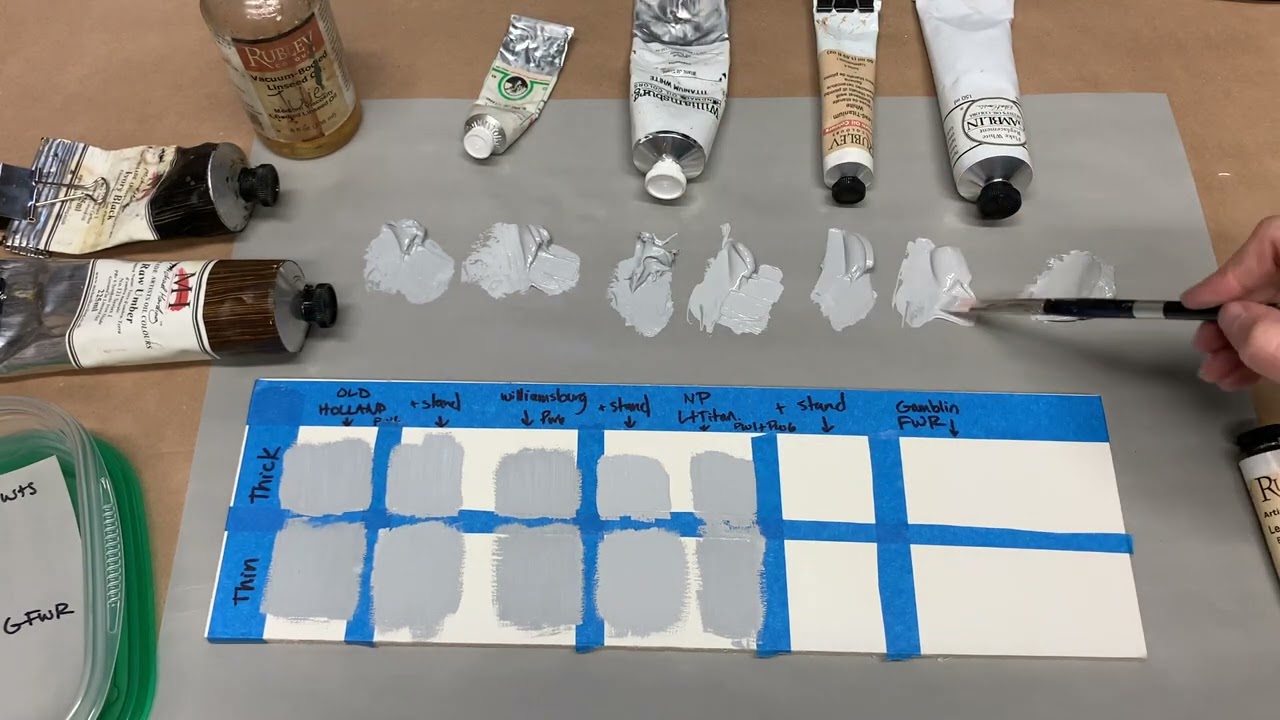
Full Testing Video from Artist Julie Beck:
Specifics and Clarifications on Julie’s on Voodoo Darkening Tests
1. Julie’s original video experiment (linked above):
-
Paint was taken straight from the tube at room temperature (Old Holland and Williamsburg titanium whites, plus Rublov lead–titanium, and Gamblin Flake White Replacement).
-
She mixed each white with a neutral (Michael Harding raw umber + ivory black), applied thick and thin swatches to Raphael oil-primed linen, and compared with samples preserved wet.
-
She also prepared parallel swatches with stand oil added.
Findings:
-
Thinner films darkened more than thicker ones, even on a white ground — a possibly counterintuitive result (but consistent with contraction/packing altering light scattering depth.)
-
Stand oil reduced but did not eliminate the darkening, while making the wet paint appear lighter and glossier.
-
Gamblin Flake White Replacement (with added stand oil) showed the least value shift, supporting the idea that added oil helps mitigate, though not remove, the phenomenon.
-
Attempts to reverse the effect by “oiling out” were unsuccessful — unlike normal sinking-in, the darkened titanium swatches did not return to their wet value.
Refrigerator/Freezer clarification:
Around 14:30 of the video, Julie shows putting portions of the mixed paints into a sealed container. I assume these mixtures were refrigerated, as this is a common method for preserving such mixtures. It is important to note, though, that the swatches that actually darkened were made with fresh, room-temperature paint. Therefore, refrigeration was not a causal factor in her darkened results here.
2. Julie’s follow-up observations (shared in our discussion):
-
She noted that thicker passages darkened less, which reinforced her suspicion that sinking-in/contraction, not transparency of the ground, was driving the effect.
-
Screenshots of these points are attached above.
3. Colleague’s refrigerated paint case (Titanium White + Phthalo Blue (specifically Williamsburg Titanium White + Williamsburg Turquoise (PW6, PG7, PB15:3)):
-
In a separate report, a colleague did refrigerate paint prior to use.
-
That mixture showed very significant darkening (see attached: left = dry, right = wet).
-
Adding Maroger Italian wax medium made the wet mixture appear lighter, but once dry it still dropped to the darker value.
-
This suggests that while medium choice can influence wet optics, the ultimate dry contraction/packing effect is still dominant.

Julie’s Video and Recent Colleague Experience Update Takeaway:
-
Julie’s tests suggest that voodoo darkening occurs without freezing or refrigeration.
-
Film thickness strongly influences the effect, with thinner films showing more dramatic shifts.
-
Mediums like stand oil or wax can change wet appearance but do not appear to prevent the dry darkening.
-
Refrigeration may aggravate the effect in some cases, but it is not a necessary trigger.
Together, these facts appear to contribute to the contraction/packing hypothesis with pigment–oil interactions (especially titanium’s high refractive index and surface activity) doing much of the heavy lifting.
8/30/25 Update George O’Hanlon’s Patchy Titanium/Bone/Ivory/Mars Black Mixes
Recently, George O’Hanlon from Natural Pigments reached out to the members of his Best Painting Practices Facebook Group to ask if anyone experienced an odd patchiness when working with Titanium White and certain black pigment mixtures. I wanted to include a summary of what he is examining and explore how it might be related to some of the mechanisms we are investigating.
Common Ground Between Julie’s Voodoo Darkening and George’s Spots
-
Timing of the shift
-
In both cases, the paint looks uniform and properly mixed when wet.
-
The darkening or spotting only manifests after drying, meaning it’s not poor mixing, surface contamination, or an immediate optical issue.
-
-
Titanium white’s role
-
Both phenomena consistently involve PW6 titanium dioxide as the white component.
-
Lead white tints, by contrast, don’t seem to show the same problems in George’s lab trials — exactly like Julie’s experience, where lead-based whites dried true to their wet value.
-
-
Migration/packing during curing
-
George suggests pigment migration within the oil film as a likely driver, possibly linked to Marangoni flow (surface tension–driven movement during solvent/vehicle evaporation) or density-driven packing.
-
This echoes the contraction hypothesis we’ve been leaning on in the voodoo darkening thread: as the binder reorganizes and contracts, titanium’s very high refractive index can often make small redistributions of oil or pigment show up as value shifts.
-
-
Optical effects linked to gloss/surface texture
-
George notes the dark spots correspond with differences in gloss.
-
Julie noted the same thing: thinner or more “sunken” passages darkened the most. Both appear to point toward localized binder absorption or redistribution, changing how light scatters and reflects at different points on the paint film.
-
Why This Strengthens the Contraction/Migration Hypothesis
-
If this were purely a pigment size disparity issue (the earlier “floating” explanation), you wouldn’t expect discrete spots to form in an otherwise uniform tint. You’d expect a more even, overall shift. Now, this might lead someone to think that there is a floating/flocculation double punch issue going on with the “patchiness,” but flocculation tends to create immediate dispersion problems (visible right away, not after drying).
-
The spotting tends to suggest localized instabilities in the drying film — micro-currents, uneven contraction, or packing differentials between the black and white pigments.
-
That matches our suspicion that the “voodoo” effect is not a mystical pigment property, but rather a manifestation of oil film reorganization during polymerization, exaggerated by titanium’s optical strength.
Key Difference to Keep in Mind:
-
George is seeing spotting in titanium + black mixtures, while Julie’s results were uniform overall darkening in titanium-based mixtures.
-
The difference may come down to the presence of a second, darker pigment (like bone black) that makes local binder shifts visibly “map” into spots, whereas in titanium + neutral mixes the same process just presents as a general value drop.
So it is possible that George’s spotting results are strongly related to the voodoo darkening phenomenon. Both can be explained by pigment migration and binder contraction/redistribution in titanium-based mixtures during drying, rather than floating or pigment quality. His ongoing testing and resulting article may give us even more insight into these mechanisms.

 I wonder how far back this Voodoo darkening was witnessed? I do believe this has a lot to do with the refractive index of the binder and it’s physical state when dried. It’s known that in the 1600s linseed oil for paint was cold pressed from the flax seeds and then water washed. I’ve done this myself as it’s easy to buy organic cold pressed flax oil though I never thoroughly tested the results for this phenomena. Artist’s materials are somewhat controlled by the large manufacturing industries for the binders, fillers, stabilizers, and pigments. All, I’m sure, have changed even from the 19th to the 20th century. The binding linseed oil saw the development and implementation of chemical and industrial refining processes with degumming, neutralization, bleaching, and deodorization. Solvent extraction methods were also developed further during this time. It’s possible too that changes again may be seen as the continuing surge for acrylic and synthetic alkyd resins take over the market. It’s becoming more difficult to buy oil based paints at the local hardware stores! For very high realist painters this Voodoo darkening would be very troublesome as refinements within an area may be difficult to match or build next to previously painted areas even when oiled in or a retouch varnish is used. When I used to make all my own oil colours - pigments hand ground with water refined cold pressed linseed oil, and I added my own homemade medium - sun-thickened water refined linseed oil, hand collected Canada balsam, homemade white dammar varnish in pure gum spirits of turpentine, the resulting paint always painted fresh went on significantly lighter, though the expected finished colour value was expected, no darkening if painted thin or thick, but that refractive index was crazy difficult to work with!