NEXT SESSION: MARCH 20:

IMPORTANT NOTICE: As mentioned in orientation, please direct all inquiries about the Alla Prima Challenges to: allaprimachallenges@gmail.com.
This week’s challenge: Getting Baked!
Getting Baked!: Synthesizing Lessons from (Nearly) the First Half
This week’s alla prima challenge, Getting Baked!, serves as a near-the-halfway point “checkpoint” in our 20-week journey, offering a break from more stringent constraints while encouraging artists to integrate the skills developed thus far. Unlike previous challenges that imposed dramatic limitations on the palette, pictorial elements, or subject constraints, this week allows for a broader range of decision-making—providing a real-time test of your developing adaptability and efficiency. By tackling a baked subject with our standard restrictions, participants must balance deliberate color selection, economy of brushwork, and efficient time management with a potential urge to devour the subject, LOL! Seriously though-- Even without our recent additional restrictions, don’t forget the importance of strategic planning and execution, ensuring that recognition survives abstraction!
Getting Baked!:
- The composition must include a baked subject. (bread, cupcake, etc.)
- Palette Restrictions: None.
- Additional restrictions : **30-minute time limit
- No premixing.**
- 5-stroke palette draw rule** in effect.
The Role of Baked Goods in Painting: A Historical Walkthrough
Baked goods have been a recurring motif in painting throughout history, serving as symbols of abundance, mortality, domesticity, and ritual. Whether depicted in lavish Baroque still lifes or modern impressionistic compositions, bread and other baked goods often carried deeper cultural, religious, or philosophical meanings. Below is an exploration of notable examples across different historical periods and artistic styles, along with an examination of their significance.
1. The Late Gothic and Early Renaissance (14th–15th Century)
Symbolic and Religious Representations
During the late Gothic and early Renaissance periods, bread often appeared in religious paintings, particularly in scenes of The Last Supper or depictions of Christ breaking bread. The Eucharistic symbolism of bread as the body of Christ made it a key element in Christian iconography.
-
Leonardo da Vinci, The Last Supper (1495–1498)
- The bread on the table serves as a central metaphor for the Christian sacrament.
- Highlights the spiritual and communal aspects of food.
-
Pieter Aertsen, The Butcher’s Stall (1551)
- A still-life genre painting that juxtaposes everyday market goods, including bread, with religious subtext (a background scene of the Holy Family).
- Suggests moral contrasts between material abundance and spiritual reflection.


2. The Dutch Golden Age (17th Century)
Vanitas and the Fleeting Nature of Life
Still-life painting flourished in the Netherlands during the 17th century, and bread often appeared alongside fruit, fish, and wine in “banquet pieces” or vanitas paintings—artworks that reminded viewers of the transience of life.
-
Clara Peeters, Still Life with Cheeses, Almonds, and Pretzels (1615)
- A meticulously painted scene showcasing baked goods as both luxurious and perishable.
- Symbolizes hospitality, trade, and the passage of time.
-
Jan Steen, The Feast of Saint Nicholas (1665–1668)
- Depicts a domestic holiday gathering where baked treats signify family unity and festivity.
- Steen’s paintings often contained moral undertones, reflecting on indulgence and human nature.


3. Rococo and Neoclassicism (18th Century)
Domestic Comfort and the Rise of Bourgeois Tastes
In the 18th century, as European society saw shifts in wealth distribution and domestic life, paintings began to emphasize everyday pleasures, including food.
-
Jean-Baptiste-Siméon Chardin, The Brioche (1763)
- A still-life that elevates a simple baked good through masterful light and composition.
- Reflects ideals of middle-class prosperity and refined taste.
-
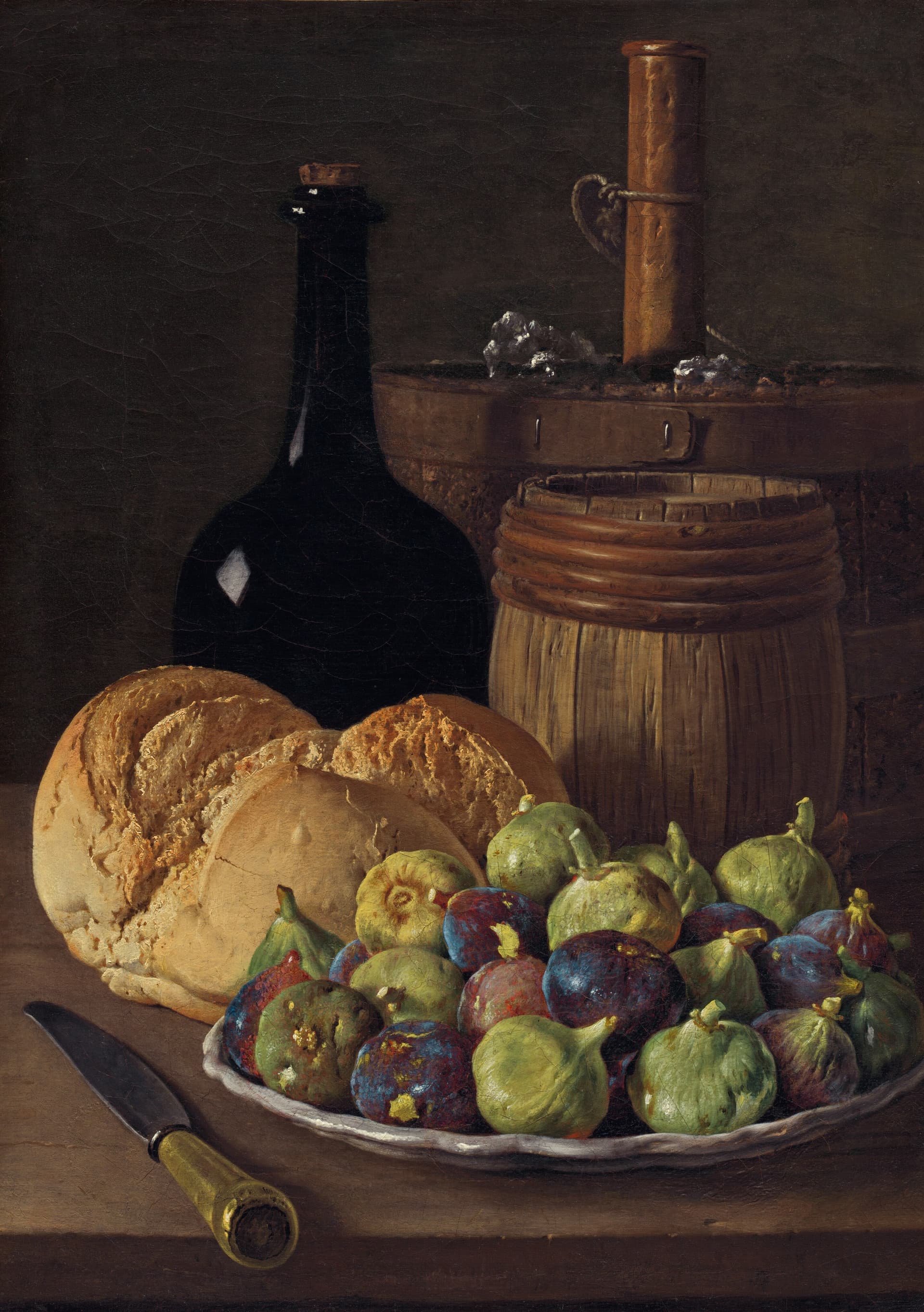
*Luis Meléndez, Still Life with Figs and Bread, (1770s)
- Captures the texture and form of bread with remarkable precision.
- Emphasizes the growing importance of everyday food items in art.

4. 19th Century Realism and Impressionism
Everyday Life and the Ephemeral
As artists moved away from idealized subjects, they increasingly depicted the realities of daily life. Bread remained a common subject, often as a symbol of labor, sustenance, or fleeting moments of pleasure.
-
Jean-François Millet, The Angelus (1857–1859)
- Portrays peasants in prayer after a day’s labor, with bread as an emblem of hard work and divine providence.
-
Édouard Manet, The Luncheon in the Studio (1868)
- A modern take on the still-life tradition, incorporating bread in a casual, contemporary setting.
- Contrasts old and new artistic traditions.
-
Claude Monet, Luncheon on the Grass (1865–1866)
- Bread as part of a relaxed, outdoor meal.
- Showcases Impressionist interest in capturing fleeting moments of light and texture.


5. 20th Century Modernism and Beyond
Symbolism, Experimentation, and Social Commentary
In the 20th century, artists experimented with form and meaning, using baked goods in unexpected ways.
-
Pablo Picasso, Still Life with Bread and Fruit Dish (1908–1909)
- A Cubist deconstruction of traditional still-life elements.
- Reinvents how we perceive ordinary objects in space.
-
Salvador Dalí, Anthropomorphic Bread (1932)
- A surrealistic transformation of bread into a strange, distorted entity.
- Explores themes of decay, desire, and subconscious imagery.
-
Wayne Thiebaud, Pies, Pies, Pies (1961)
- A Pop Art celebration of commercialized food culture.
- Emphasizes color, repetition, and the nostalgic appeal of baked goods.


In Summary
From religious symbolism in the Renaissance to the commercial aesthetics of Pop Art, baked goods have played a dynamic role in painting across centuries. Whether as a representation of faith, wealth, domesticity, or artistic innovation, they continue to provide rich visual and conceptual material for artists. This week’s alla prima challenge is an opportunity to engage with this tradition, applying modern techniques to a timeless subject! Let’s see how you approach it this week with Getting Baked!
ALLA PRIMA GALLERY FOLDER FOR CHALLENGE #9:
Again, any completed all prima exercise can be sent to: allaprimachallenges@gmail.com. We will add your effort to the appropriate Dropbox folder.